

















For years, digital visibility meant one thing: getting onto the first page of Google.
Brands invested in keywords, backlinks, technical SEO and content with one main goal. Rank higher, get the click and bring people to the website.
That still matters. But people are no longer searching in the same way.
Today, someone can ask an AI assistant to compare companies, recommend a product or explain a complicated topic. They can get surprisingly far into their research without opening a single website.
Search hasn’t disappeared. It has just stopped looking like search.
And that is where the conversation around SEO vs AEO vs GEO begins.
SEO Still Matters, But Search Is Changing
Despite countless predictions about its death, Search Engine Optimisation (SEO) remains important.
People still turn to Google to find jobs, restaurants, companies, products and services. Businesses still benefit enormously from appearing prominently in those results.
But the traditional journey used to be fairly predictable.
Someone searched. Google showed them a list of websites. They chose one and clicked.
Now, the answer can appear before the click.
Google itself has published guidance on optimising for generative AI features, while stressing that the same SEO fundamentals remain relevant for appearing in its AI-powered search experiences.
For brands, that means ranking is no longer the only measure of whether people can find you.
What Is AEO?
Answer Engine Optimisation (AEO) focuses on helping platforms understand and surface clear answers from your content.
Think about how people actually search.
Someone might once have typed “best CRM small business” into Google. Today, they might ask, “What’s the best CRM for a five-person sales team?”
The intention is similar, but the expectation is different.
The person isn’t necessarily looking for ten websites to explore. They want someone to answer the question.
AEO is about making your content clear and useful enough to provide one.
Instead of burying useful information underneath introductions written primarily for keywords, content needs to answer genuine audience questions clearly. That matters even more as audiences become increasingly selective about generic AI-generated content and look for information that actually offers something useful.
FAQs, comparisons, definitions and practical guides can all help. But the point isn’t to turn every page into a long list of questions and answers.
It’s to understand what people actually want to know and give them the information without making them work for it.
What Is GEO?
Then comes Generative Engine Optimisation (GEO).
GEO looks at whether generative AI systems can understand a brand, its expertise and the information surrounding it well enough to potentially include it in generated responses.
Imagine someone asking an AI assistant to recommend agencies in Egypt, compare software platforms or identify companies working within a particular industry.
Some businesses may appear in that conversation. Others may not.
That creates a different question for marketers:
Does AI know enough about your brand to understand what you should be known for?
This is where GEO goes beyond simply optimising a webpage.
Strong website content matters, but so can original research, case studies, expert commentary, media coverage, reviews and credible mentions elsewhere online.
The goal becomes bigger than convincing a search engine that one page deserves to rank.
It is about building enough digital authority for your brand to be understood and trusted.
SEO vs AEO vs GEO Is Not Really a Competition
The rise of AEO and GEO has naturally created another round of “SEO is dead” conversations.
But businesses probably don’t need to choose one.
A useful article can rank in traditional search, provide a clear answer to a specific question and contribute to the authority surrounding a brand at the same time.
That is why the distinction between SEO vs AEO vs GEO is useful, but creating three completely separate strategies may not be.
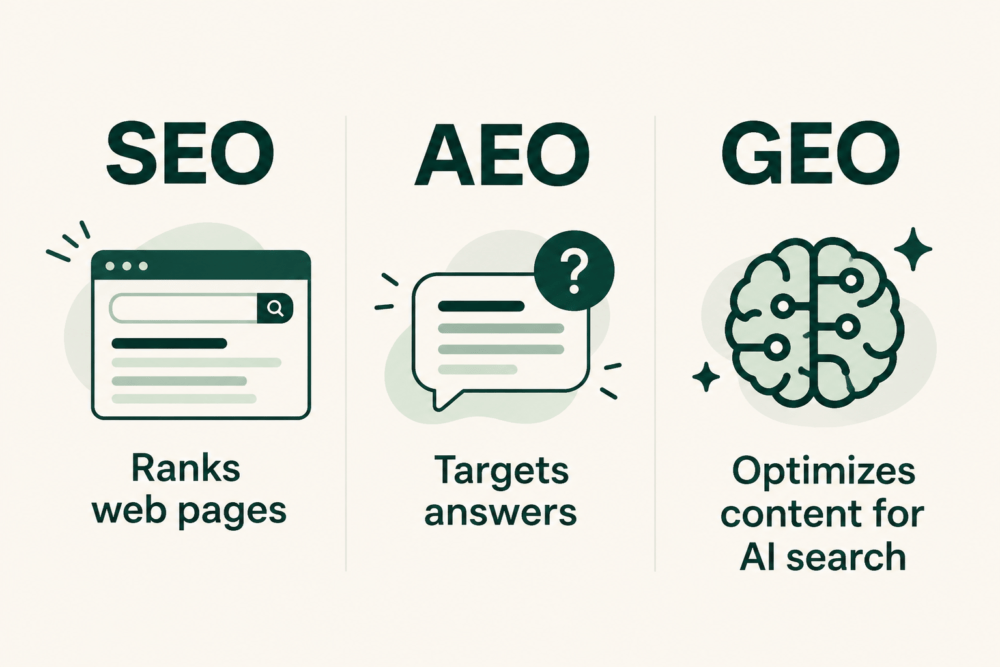
SEO helps people discover you through search engines.
AEO makes your information easier to surface when someone wants an immediate answer.
GEO focuses on whether your brand and expertise can become relevant within generative AI responses.
They are different parts of an increasingly connected search environment.
Search Is Becoming Everyone’s Problem
Perhaps the more interesting change is what this means inside marketing teams.
SEO traditionally belonged to SEO specialists. PR handled media coverage. Social teams handled platforms. Content teams wrote articles. Brand teams worried about reputation.
Those lines are becoming much harder to maintain.
A strong media mention can contribute to the authority surrounding a company. Original research can earn backlinks and give other sources something worth referencing. Expert thought leadership can help establish what a person or company should be known for.
As AI becomes part of everyday marketing and workplace decisions, the question is no longer whether businesses will use it, but how intelligently they will use it. The same conversation is already happening around how technology is changing the workplace, where the value increasingly comes from how people work with technology rather than simply having access to it.
Search visibility is becoming connected to a much bigger digital footprint.
Which means search is slowly becoming everyone’s problem.
Do Brands Really Need Three Strategies?
Probably not.
This is where marketing has a habit of making things more complicated than they need to be.
A new acronym appears and suddenly everyone needs a new strategy, a new specialist and a presentation explaining why everything has changed.
But SEO, AEO and GEO overlap more than their names suggest.
A genuinely useful article can rank on Google, answer a specific question and help establish a brand’s authority at the same time.
Good PR can earn coverage while strengthening the credibility surrounding a company.
Original research can attract backlinks, answer questions and give both people and AI systems something worth referencing.
The point isn’t to create three versions of everything.
It’s to stop thinking about visibility as nothing more than a Google ranking.
The Bigger Shift Is From Rankings to Authority
This may be the part that matters most.
For a long time, digital marketing was obsessed with getting people to find you.
Now brands also need to think about what happens when platforms start answering on their behalf.
Are you useful enough to reference?
Is your expertise clear?
Do other credible sources recognise you?
Is there enough information online for people and AI systems to understand what you should be known for?
Keywords still matter. Rankings still matter. Technical SEO still matters.
But they’re becoming pieces of a much larger picture.
The temptation will be to chase every new acronym. That probably isn’t necessary.
The more sustainable approach is remarkably familiar: create useful content, answer real questions, build expertise, earn credible mentions and make it easy for people and technology to understand what your brand actually does.
SEO isn’t dead.
AEO isn’t replacing it.
GEO isn’t making everything marketers learned before AI irrelevant.
Search is simply becoming bigger than Google.
And the brands that benefit may not only be the ones sitting at the top of a search results page.
They’ll be the ones that have built enough authority to show up wherever the answer comes from.