

















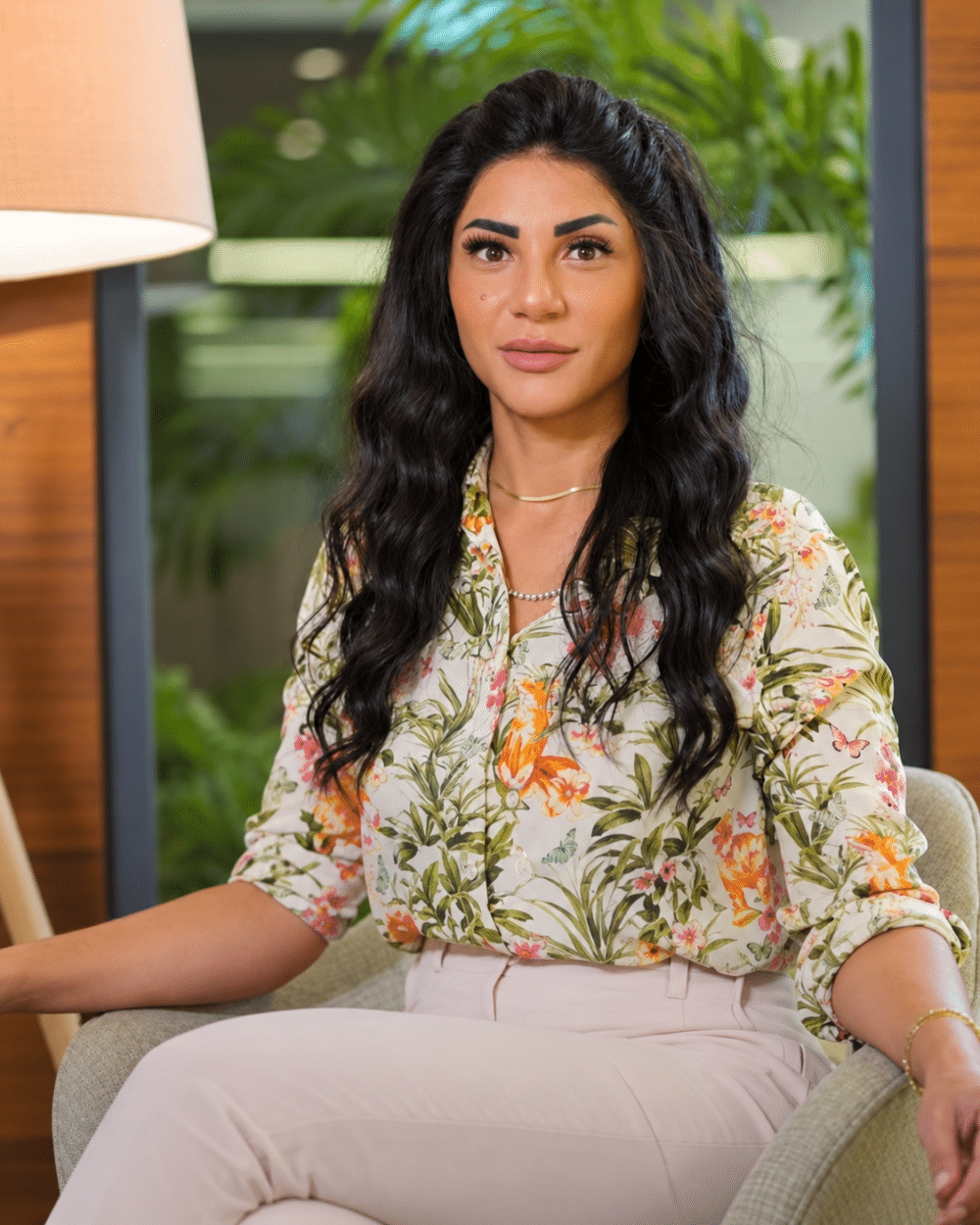

In a conversation with 925, Dr. Yomna Badr reflects on the career decisions that shaped her, the management habits she believes need to change, and why the people she has helped develop remain her proudest achievement.
There is a question we often find more interesting than asking someone how they become successful. After everything they’ve accomplished, what are they actually most proud of?
For Dr. Yomna Badr, the answer wasn’t a business milestone, a successful brand, or another title added to her CV. It was the people she had helped develop along the way.
With more than 18 years of experience across pharmaceuticals, marketing, and executive leadership, Dr. Yomna has worked with companies including Fresenius Kabi, Danone, Pfizer, and Bioderma. Today, she serves as Marketing Board Advisor at ECC Group and Marketing Director at Infinity Clinic Pharma, having contributed to the development of brands including Infinity Naturals, Infinity Supplements, Infinity Spanish Labs, Source Beauty, MYVI, and Skinify.
She’s also the co-founder of Career Gossips, a career and leadership development platform that has trained more than 5,000 professionals and worked with over 30 companies across the Middle East and Canada.
Beyond her professional achievements, we wanted to understand what nearly two decades of building brands, managing teams, and making difficult decisions had taught her about business, leadership, and the people behind both.
925: How has your pharmacy background shaped the way you build and market brands?
Dr. Yomna Badr: My education in pharmacy gave me much more than a scientific foundation. It shaped the way I understand markets, products, and ultimately, how I build brands.
It prepared me to begin my career in pharmaceutical sales, which exposed me early on to an extremely competitive, performance-driven environment. It taught me how to study competitors, understand the market, communicate value effectively, and consistently deliver results.
My scientific background also gave me a deeper understanding of R&D, active ingredients, formulations, and manufacturing.
Today, I don’t look at a product purely from a marketing perspective. I look at the science behind it, the competition it will face, the consumer needs it addresses, and how we can translate all of that into a compelling brand proposition.
925: What have global and regional companies taught you about building brands for local markets?
Dr. Yomna Badr: Starting my career with multinational companies gave me a strong foundation in what it truly means to build a brand. A brand is far more than a logo or a product. It is a complete identity, built through clear guidelines, a distinctive tone of voice, a consistent visual language, and communication messages.
But it also taught me an important lesson: global excellence must be translated through a local lens. Strong brand principles may be universal, but communication must reflect the realities and behaviors of each market.
I experienced this firsthand when working with sunscreens in 2007. At the time, it required significant awareness and persistence to convince stakeholders that sunscreen wasn’t simply a cosmetic or seasonal product, but an essential part of a skincare routine.
That experience taught me that building brands locally isn’t always about responding to existing demand. Sometimes, it’s about creating awareness, changing perceptions, and shaping new consumer behaviors.
925: What tells you that an idea has the potential to become a strong brand, not just another product?
Dr. Yomna Badr: I believe it needs to be built on two fundamental insights: a strong data insight and a strong consumer insight.
The numbers need to demonstrate a meaningful market opportunity, but behind those numbers, there must also be a genuine consumer need, pain point, or aspiration that the brand can address.
Today, that alone is no longer enough. Consumers don’t simply purchase products; they purchase feelings, experiences, and a sense of connection.
The real turning point is when you move beyond product functionality and begin building emotional relevance. When consumers feel that a brand understands them, fits naturally into their routines, and connects them to a community they identify with, you create a brand they actively choose to keep in their lives.
925: At the board level, where do you think companies still underestimate the role of marketing?
Dr. Yomna Badr: There was certainly a time when marketing faced significant resistance at the board level, particularly in our industry. It was often viewed as an expense that required substantial spending, while its financial return could take time to materialize.
As a result, many companies relied more heavily on sales and price-based competition.
However, competing primarily on price is neither sustainable nor necessarily profitable in the long term. There will always be someone willing to offer a lower price.
Today, boards increasingly recognize that marketing and branding aren’t simply support functions for sales. They are fundamental drivers of business growth, creating demand, strengthening consumer loyalty, and contributing to profitability.
The conversation has shifted from “How much are we spending on marketing?” to “How effectively are we investing in our brand?”
925: What does it take to build a team that can think and lead independently?
Dr. Yomna Badr: My team has been one of my greatest blessings. There are countless theories about building high-performing teams, but through my experience, I’ve come to believe that one element sits at the foundation of everything else: safety.
People perform at their best when they feel secure, trusted, and supported.
When employees constantly worry that their manager is waiting for them to make a mistake, their energy shifts away from achievement. Instead of focusing on solving problems and reaching their objectives, they begin focusing on protecting themselves.
One of a leader’s most important responsibilities is to create an environment where people feel safe enough to think independently, speak openly, challenge ideas, make decisions, and even make mistakes without fear.
Once people know their leader genuinely stands behind them, they become more confident in their judgment and more willing to take ownership. That’s when you start building a team of people who can eventually lead on their own.
925: Through career coaching and training, what career challenges do professionals often misunderstand about themselves?
Dr. Yomna Badr: Across almost every assessment we conduct, whether with individuals or organizations, I consistently see three challenges emerge.
The first is the transition from being a high-performing professional to becoming a leader. People are often promoted because they excel at their jobs, but leadership requires an entirely different skill set.
Your role shifts from delivering your own work to guiding people, motivating teams, delegating, and managing different personalities. When professionals struggle with this transition, they often question their abilities when, in reality, they simply haven’t been taught how to lead.
The second challenge is communication. We often assume that what we say is what the other person understands, but that isn’t always the case. Effective communication is about knowing what to say, how to say it, when to say it, and who you’re speaking to.
Finally, and perhaps most importantly, is emotional intelligence. Without self-awareness, it becomes difficult to manage stress, frustration, fear, or anger, and those emotions inevitably influence how we lead and make decisions.
Ultimately, career progression is no longer just about becoming better at your technical job. At a certain level, success depends on how well you understand yourself, communicate with others, and lead people.
925: After 18 years, what do you hope your biggest legacy will be: the brands you built or the leaders you developed?
Dr. Yomna Badr: I’m incredibly proud of both. It’s deeply rewarding to look back at the brands I’ve helped build and know that I played a role in their success.
But if I had to choose what makes me proudest, without hesitation, it would be the people I’ve developed along the way.
Watching talented professionals grow, discover their capabilities, gain confidence, and eventually become leaders themselves is something I consider one of my greatest achievements.
Behind every successful brand are the people who made it happen. No strategy, campaign, or business milestone is achieved by one person alone.
When I think about legacy, I hope mine is reflected in the people I’ve supported. If they go on to build great brands, lead great teams, and create opportunities for those who come after them, that’s a legacy I would be truly proud of.
925: What is one quality you value most in people you work with?
Dr. Yomna Badr: Positivity, without question. It’s the number one quality I value because it influences almost everything else.
Positivity doesn’t mean ignoring challenges or pretending problems don’t exist. It means having the mindset to face challenges with resilience, focus on solutions, and keep moving forward.
Positive people approach problems differently. They make clearer decisions under pressure, motivate themselves and those around them, and remain ambitious even when circumstances are challenging.
Skills can be developed and experience can be gained, but mindset has an extraordinary impact on how someone uses both.
925: What is one leadership habit you wish managers would unlearn?
Dr. Yomna Badr: Micromanagement. It’s one of the most damaging habits managers need to unlearn.
Leadership is about managing objectives and outcomes, not controlling every detail of how someone gets there.
When managers become involved in every step of execution, they exhaust themselves and limit the confidence, creativity, and independence of their teams.
If someone on my team approaches a task differently from how I would, but consistently delivers excellent results, I believe in letting them do it their way.
Sometimes their approach may even be better than mine, and a good leader should be willing to learn from it.
The goal isn’t to create people who think and work exactly like you. It’s to create an environment where talented people can use their own strengths and judgment to achieve results.
925: Are you more instinct-driven or data-driven when making a big decision?
Dr. Yomna Badr: Big decisions should always be grounded in data. I would never underestimate the importance of numbers, research, and evidence, but data alone cannot always give you the complete picture.
Instinct also plays a role, particularly as you become more experienced and move into senior leadership positions.
What we call instinct at that level isn’t simply a feeling or an emotional reaction. It’s the result of years of experience, pattern recognition, and market exposure.
Data can tell you what is happening and what has happened, while experience helps you interpret what might happen next.
I would say I’m predominantly data-driven, but I leave room for informed instinct. The strongest decisions often come from knowing how to balance the numbers with the perspective that only experience can build.
925: What is one piece of career advice you wish you had heard earlier?
Dr. Yomna Badr: About eight years ago, someone gave me a piece of advice that I wish I had heard much earlier in my career: “Make a decision. Right or wrong, make a decision.”
Decision-making is one of the most important skills we develop throughout our careers. Yet so much time and opportunity can be lost when we become paralyzed by the fear of choosing incorrectly.
When you make a decision, there’s always a possibility that you’ll be right or wrong. But when you refuse to decide, you’ve already lost the opportunity to move forward, learn, and adapt.
I believe indecision can sometimes be far more damaging than making the wrong choice.
This is also something I strongly believe in as a leader. People should be given the authority to make decisions appropriate to their responsibilities, and that includes permission to occasionally make the wrong ones.
Mistakes are an essential part of professional development. You learn what works because, at some point, you experience what doesn’t.
People don’t develop by always being told the right answer. They develop by being trusted to find it.