
















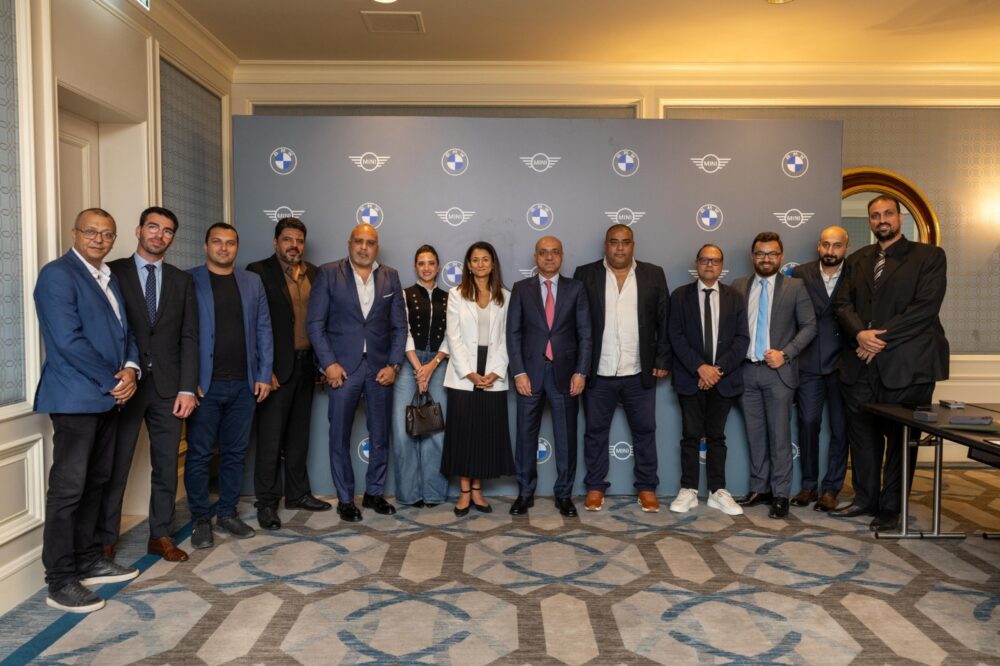

At a Cairo roundtable with BMW Group and Global Auto, one question kept resurfacing in different forms: what happens to a premium automotive brand when China changes the speed, technology, and economics of the entire industry? BMW’s answer is not to become cheaper. It is to make the meaning of premium harder to copy.
Written by EIC Nadine Mustafa
The automotive industry has a new centre of gravity.
Chinese carmakers are no longer entering global markets simply by competing on price. They are arriving with sophisticated technology, faster product cycles, increasingly strong quality, and a very different idea of what a car should offer its owner. In Egypt, that change is particularly visible. The market now hosts around 45 Chinese automotive brands, according to figures discussed during a recent BMW and Global Auto roundtable. For established premium manufacturers, that creates a more complicated question than simply, “How do you compete?” The real question is what happens to the definition of premium when customers can find large screens, advanced software, driver assistance systems, comfort features, and electric technology across a much wider range of price points. BMW is watching that shift closely. But one thing became clear during our conversation with Ritu Chandy, Head of the BMW Group Sales Region Asia Pacific, Eastern Europe, Middle East and Africa, and Mohamed Kandeel, CEO & Managing Director of Global Auto Group: BMW has no intention of fighting that battle through discounts alone.
We Started with the Question Everyone Was Thinking: What Does Premium Mean Now?
For decades, the premium car formula was relatively straightforward. Brand heritage, engineering, performance, design, and status created a clear line between the premium segment and the rest of the market. Technology has made that line less obvious. Today, a customer can step into a far less expensive car and find a long list of digital features that once belonged almost exclusively to premium vehicles. Chandy did not dismiss what Chinese manufacturers have achieved. In fact, she repeatedly acknowledged their speed, quality, production efficiency, and ability to bring technology to customers quickly. But BMW’s response, she explained, is built around the idea that premium cannot be reduced to a feature list. It includes what happens before the customer buys the car, what happens when they collect it, how the car drives, how quickly a service appointment can be booked, whether a spare part is available, and what ownership feels like three, four, or five years later. BMW has around 120,000 trained service technicians globally, according to Chandy, and vehicles undergo around 1.75 million kilometres of testing before reaching customers. That philosophy also explains why BMW is reluctant to enter the aggressive pricing cycle currently affecting parts of the automotive market. For Chandy, repeatedly cutting prices does more than reduce margins. It can damage the value customers believe they purchased. If someone buys a car today and sees it offered at a significantly lower price only months later, the conversation is no longer simply about discounts. It becomes a conversation about the value of the asset they own. That matters even more in Egypt.
Then We Brought the Conversation Home to Egypt
Egypt presents BMW with a market that behaves differently from many mature economies. Currency movements, import restrictions, supply fluctuations, and economic uncertainty can reshape demand quickly. At the same time, vehicles can function as both transportation and a way of preserving value. Despite these fluctuations, Chandy said the premium segment has shown a degree of resilience in absolute volumes over the past years. BMW is betting that customers will continue to differentiate between the initial cost of a vehicle and the full experience of owning one. That includes service, parts, warranties, resale considerations, and the relationship a customer builds with the brand over time. And in a market where cars can carry considerable financial weight for their owners, protecting that relationship becomes part of protecting the product itself.
But What About the Customer BMW Is Trying to Win Next?
The other challenge is generational. BMW may have enormous brand recognition, but younger customers are entering an automotive market with far more choices than previous generations had. They also judge cars differently. Connectivity, software, interfaces, technology, and personalisation can matter as much as the badge on the bonnet. Interestingly, BMW already sees that younger customer entering its portfolio in Egypt. Chandy said the average customer age within BMW’s UKL and KKL segments in Egypt is around 28. These segments cover models including the 1 Series, 2 Series, X1, X2, 3 Series, 4 Series, X3 and X4, alongside parts of the MINI portfolio. That does not necessarily mean BMW expects to become somebody’s first purchase immediately after university. The economics of a premium vehicle still create a natural barrier. But it does suggest that the traditional picture of the BMW buyer is changing. The wider BMW Group portfolio gives it several entry points into that audience. MINI speaks to customers drawn to design and individuality, while BMW M continues to attract people whose relationship with cars is driven heavily by performance. The next challenge is keeping all of those customers interested in an era when technology ages faster than cars do. That is where Neue Klasse enters the conversation.
That Brought Us to Neue Klasse
If there was one subject Chandy repeatedly returned to, it was Neue Klasse. For BMW, it is more than an electric vehicle platform. It represents a change in how the company thinks about the architecture of the car itself. The BMW iX3, the first production model built around Neue Klasse, has become the clearest expression of that shift. But the more important change is happening underneath the awards and headlines. BMW has redesigned the electronic architecture around four central computing systems. The intention is to create vehicles that can continue receiving new functions and software throughout their life rather than allowing their digital experience to become dated shortly after purchase. It reflects a lesson the entire car industry has had to learn from technology companies. Hardware can remain relatively stable. Software cannot. That also changes the idea of what a vehicle is. Chinese brands have been particularly aggressive in treating the cabin as what Chandy described as a living space, filling it with screens, entertainment, comfort features, voice systems, massage functions, and increasingly sophisticated digital experiences. BMW is taking a different visual direction. Rather than simply adding larger displays, Neue Klasse introduces BMW Panoramic Vision, placing information across the lower section of the windscreen and changing how passengers and drivers interact with the vehicle. The question BMW is trying to answer is not whether it can add more technology. It is whether that technology still feels like a BMW once it is there.
And BMW Is Not Looking Away from China
Perhaps one of the more interesting parts of the conversation was how openly BMW discussed China. There was little attempt to minimise the progress Chinese manufacturers have made. Chandy described some Chinese brands as offering genuinely strong technology, respectable quality, intelligent manufacturing systems, and remarkable development speed. BMW does not intend to watch that development from Munich. The company has its own research and development presence in China and is actively working with local technology companies to operate closer to what Chandy called “China Speed.” For its Chinese market vehicles, BMW has worked with companies including Alibaba and Momenta, incorporating local large language models and driver assistance technology designed specifically around Chinese customer needs. That partnership model is important. BMW does not believe every piece of technology inside a BMW has to be developed entirely by BMW. Its role is increasingly about selecting the right technology, integrating it properly, and ensuring the result still behaves and feels like one of its cars. The company takes a similar approach elsewhere. Qualcomm, for example, is among its technology partners for driver assistance systems. Even artificial intelligence follows that mixed model. BMW has used AI applications within manufacturing and quality control for years. Today, its use is expanding across vehicle technology, driver assistance, software, internal processes, and customer functions. Sometimes BMW builds internally. Sometimes it works with technology companies. The decision depends on the problem it is trying to solve.
Then Came the Cost Question
That partnership strategy is also part of a much bigger cost conversation. BMW knows that established automotive manufacturers cannot ignore the economics that have helped newer competitors move faster. Chandy acknowledged that BMW is simplifying its own cost structure, reducing complexity, reassessing certain vehicle variants, and questioning where bespoke development is genuinely necessary. That does not mean outsourcing the characteristics customers associate with BMW. It means becoming more selective about what deserves to be developed independently. If an existing component or platform can perform a function well and the customer does not consider that component fundamental to the BMW experience, developing another version simply for the sake of doing so may no longer make financial sense. The distinction is important. BMW is prepared to share solutions. It is not prepared to share its identity. For the company, driving dynamics, the way technology is integrated, the customer experience, and the characteristics that make the car recognisable as a BMW remain areas where it wants control.
So We Asked: Could China Become a BMW Export Base?
In some cases, it already is. BMW currently exports vehicles produced in China to certain ASEAN markets where trade agreements make that commercially viable. Assembly kits also move from Chinese facilities to some production locations within the wider network. But China will not become BMW’s single global manufacturing centre. 925 MEA 4 The reason is partly strategic and partly geopolitical. BMW operates production across Germany, China, the United States, and several assembly markets, including Egypt, India, and Thailand. That spread gives the company more room to respond to tariffs, trade restrictions, political changes, and regional demand. A vehicle that makes sense to manufacture in China for one market might make very little sense for another. That flexibility has become more valuable as global trade becomes less predictable.
And Where Does Egypt Fit into What Comes Next?
Egypt is already part of BMW’s production network. Together with Global Auto, BMW locally assembles the X3, X5, X6 and X7 through its SKD operations. The bigger question is what comes next. Could more models be assembled locally? Could Egypt eventually play a role in exports? Could electric vehicles become part of that manufacturing story? Chandy stopped short of announcing new models or investments, stressing that decisions depend on tariffs, economics, geopolitical conditions, and the needs of individual markets. Kandeel, however, was clear that Egypt should continue creating conditions that make automotive investment worthwhile. Potential customs duties on imported electric vehicles, while locally assembled EVs receive different treatment, could help create that incentive. For Kandeel, even a relatively modest shift in that direction would matter. Egypt has spent years building its internal combustion vehicle assembly base. There is no fundamental reason, he argued, why electric vehicle production should be considered out of reach. But isolated customs decisions will not be enough. What the industry needs, in his view, is a wider automotive strategy that encourages investment, supports local suppliers, creates employment, and gives manufacturers enough visibility to make long term decisions.
Then There Was the Question Every BMW Purist Wanted Answered
For longtime BMW enthusiasts, one concern remains much more emotional. What happens to the internal combustion engine? BMW’s answer is simple: it is staying. Chandy confirmed that BMW will continue producing internal combustion vehicles, although that does not mean every model will continue to offer both powertrains. The X4, for example, will not return with an internal combustion engine. Other models including the 3 Series, X3 and X5 will continue to offer combustion options. At the same time, BMW believes electric performance may persuade some of its most traditional customers to reconsider what they expect from a performance car. The company is already preparing an electric M3, which Chandy described as delivering an entirely different type of driving experience through its four electric motors and new vehicle technology. BMW does not appear interested in forcing every customer down one road. Its strategy is increasingly about keeping several roads open.
By the End, It Was Clear This Was Never Just About Price
After nearly every part of the automotive industry came into the conversation, from China and artificial intelligence to Egypt, electric vehicles, manufacturing, software, pricing, service, and performance, the same idea kept returning. BMW knows Chinese manufacturers have changed the market. It also knows pretending otherwise would be a mistake. Some have strong products. Some have strong technology. Many move extraordinarily fast. Others may disappear as competition forces the Chinese automotive sector to consolidate. BMW’s response is not to imitate everything they do. Nor is it to rely only on history and assume the BMW badge will carry the company through another generation of customers. Instead, the bet is that premium can still mean something distinct, provided the definition keeps moving. That means cars that can change through software. It means using technology partners without surrendering the driving character of the vehicle. It means reducing unnecessary cost without turning the product into a commodity. It means manufacturing in different parts of the world rather than depending on a single country. And in Egypt, it means treating the market as more than somewhere to sell imported cars. Chinese manufacturers have forced almost every global carmaker to move faster. The more interesting question now is not whether BMW can keep up. It is whether BMW can move at that speed and still feel unmistakably like BMW.